

Couplers for dispensing beer and beverages connect the keg with the product line and the gas or drive system. Choosing the correct coupler prevents leaks, foam, lack of flow, incompatibilities and safety issues in home, event and hospitality installations.
Quick answer: which coupler you need to dispense beer or a beverage
You need a coupler compatible with the keg valve. There is no universal coupler for all kegs. The most common systems include type A, D, G, L, M, S, U, KeyKeg couplers and Cornelius Ball Lock or Pin Lock connectors.
Before buying, you must confirm four points: keg type, valve type, product outlet and gas or drive inlet. Then you check threads, barbs, fittings, non-return valves, working pressure, cleaning and compatibility with the rest of the installation.
You know which keg you have, but not which coupler you need?
At Install Beer we can help you identify the correct coupler for your beer keg, KeyKeg, Cornelius or alternative beverage. Send us a photo of the top valve of the keg and we will check compatibility.
See keg couplers Check compatibilityWhat a keg coupler is and what it’s used for
The keg coupler, also called coupler or extractor, is the part that allows the keg to be connected to the dispensing system. Its function is to open the keg valve, allow gas or pressure in, and let the beverage flow out to the line, the cooler and the tap.
In a professional setup, the coupler should not be chosen just for its appearance. It must be compatible with the keg, with the gas or driving system, with the beverage connections, with the working pressure and with the cleaning routine.

Main parts of a dispensing coupler
Although each model may vary, most beer and beverage couplers share a similar functional structure.
Coupler body
This is the main piece that connects to the keg valve. It must match the corresponding valve system: A, D, G, L, M, S, U, KeyKeg or another format.
Lever or closing mechanism
Allows you to engage the coupler and open the beverage and gas passages. It should only be operated when the coupler is correctly fitted.
Product outlet
This is the connection where the beverage exits towards the tubing, cooler, tower or tap. It may require a barb, thread, BSP adapter or push-fit fitting.
Gas inlet or drive
Allows CO₂, blend gas, compressed air, or compatible pressure to be introduced depending on the type of keg and beverage.
Check valves
They help prevent beverage from flowing back into the gas line or other unwanted backflow in the system. They are important for safety, hygiene, and maintenance.
Gaskets and sealing elements
They ensure a tight seal. If they are worn, you may get leaks, foam, loss of pressure or connection problems.
Types of couplers for beer and beverages on tap
The type of coupler depends on the valve installed on the keg. The following table serves as a general guide to understand the most common systems. Actual compatibility must always be confirmed with the producer, distributor or the keg’s technical sheet.
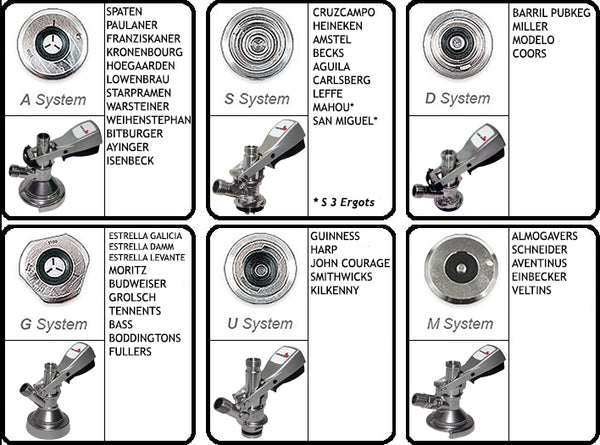
| Coupler type | Usual use | What to check before buying | Recommended approach |
|---|---|---|---|
| Type A | Beers and beverages in kegs with type A valve. | Keg valve, threads, product outlet and gas inlet. | See type A coupler |
| Type D | Kegs with D-type valves, common in some international systems. | Keg compatibility, pressure, and line connections. | View type D coupler |
| Type G | Beers and beverages with type G valve. | Keg type, BSP or barb outlet, and compatible gas. | View type G coupler |
| Type L | Some drinks, alcohol-free beers, radlers or other specific formats. | Always confirm the keg valve before buying. | See L-type coupler |
| Type M | Kegs with M-type valve. | Valve and connection fitting compatibility. | See coupler collection |
| Type S | Widely used in beer kegs for hospitality. | Keg valve, connections, pressure and seals. | See type S coupler |
| Type U | Some specific beers and kegs. | Confirm with producer or distributor. | View available couplers |
| KeyKeg | One-way kegs with inner bag for beer, wine, kombucha, cider, vermouth or other beverages. | KeyKeg coupler, safety, depressurization, check valves and connections. | See KeyKeg |
| Cornelius Ball Lock / Pin Lock | Homebrewing, kegerator, trials, small batches and home dispensing. | Distinguish gas and product connections, Ball Lock or Pin Lock. | See homebrewing |
How to identify which coupler you need
The safest way is to identify the keg valve. If you don’t have a technical sheet, you can check the top of the keg and compare the connection system. A clear photo from above is usually enough for a technician to advise on compatibility.
| Pitch | What to check | Why it matters |
|---|---|---|
| 1. Identify the container | Metal keg, KeyKeg, Cornelius, plastic keg, bag-in-keg or another format. | Each container may require a different connection system. |
| 2. Look at the top valve | Shape, lugs, flange, depth, rotation, and coupling system. | The valve determines the type of coupler. |
| 3. Confirm drink and pressure | Beer, wine, vermouth, cider, kombucha, nitro coffee, soft drink or cocktail. | The beverage determines gas, cleaning, material, and maintenance. |
| 4. Check product outlet | Thread, barb, BSP, John Guest, 3/8" tube, 5/16" tube or another size. | Avoid buying the right coupler but with the wrong connections. |
| 5. Check gas inlet | CO₂, blend, compressed air or system recommended by the manufacturer. | An incorrect gas can affect quality, safety and shelf life. |
| 6. Check cleanliness | Access, disassembly, seals, check valves and cleaning products. | A dirty coupler or one with damaged seals affects flavor and dispense. |
Send us a photo of the keg valve
If you don’t know whether you need type A, S, G, D, L, M, U, KeyKeg or Cornelius, send us a clear photo of the top valve of the keg and we’ll help you identify the coupler and the necessary connections.
Request technical help Buy couplersCorrect coupler, correct connections
Choosing the right coupler is only the first step. Then you must correctly connect the beverage outlet and the gas inlet. This is where errors in size, thread, barb, tubing or fitting usually appear.
Beverage outlet
It can be connected via thread, barb, BSP adapter or quick connector. You must confirm whether the line uses 3/8", 5/16", 1/2" or another tube size.
Gas inlet
It must be compatible with CO₂, mixed gas, compressed air or the system recommended for the container. Also check non-return valves and safety valves.
BSP threads
Many couplers use BSP threads. They must not be confused with tube sizes: 3/8" tube is not the same as 3/8 BSP thread.
Tubes and fittings
The tube must be compatible with beverages, pressure, cleaning and the outer diameter required by the fitting. A poorly chosen tube can cause leaks or loss of flow.
KeyKeg couplers: when to use them
KeyKeg couplers are used with KeyKeg kegs, a one-way keg system with an inner bag. They are common in craft beer, wine, cider, kombucha, vermouth and other beverages that you want to dispense on tap while keeping the beverage separate from the drive gas.
With KeyKeg it is especially important to check safety, depressurization, non-return valves and correct system connection. Not all KeyKeg couplers have the same connections or the same intended use.
KeyKeg Micro Matic coupler
Solution for connecting KeyKeg kegs to the tower, gas and product line system.
KeyKeg DSI coupler
KeyKeg solution with a technical focus for safe, stable and hygienic dispensing.
Cornelius, Ball Lock and Pin Lock
Cornelius kegs, also known as Corny Kegs, are widely used in homebrewing, kegerators, trials, small batches and home dispensing. Unlike traditional commercial kegs, they usually use separate connectors for gas and beverage.
| System | Usual use | What to check |
|---|---|---|
| Ball Lock | Homebrewing, kegerator, and home dispensing. | Differentiate gas and product connectors; do not swap them. |
| Pin Lock | Some Cornelius kegs and home systems. | Confirm connector type before buying accessories. |
| Cornelius / Corny Keg | Small batches, trials, homebrew or experimental drinks. | Check pressure, seals, fittings, tube, and keg cleanliness. |
Common mistakes when buying a coupler
- Buying by beer brand without confirming the keg valve.
- Confusing S-type, G-type or A-type couplers by appearance.
- Not checking whether the coupler needs additional barbs or adapters.
- Confusing BSP thread with tube size.
- Not checking gas inlet and beverage outlet.
- Not checking whether the coupler includes check valves.
- Using worn gaskets or not replacing them when there are leaks.
- Not cleaning the coupler regularly.
- Forcing a coupler that doesn’t fit correctly.
- Not checking pressure and safety before activating the system.
Common problems: how to know if the coupler is failing
When an installation doesn’t pour properly, the coupler can be one of the causes. Even so, it’s advisable to check the entire system before changing parts.
| Symptom | Possible relation to the coupler | What to check |
|---|---|---|
| No beverage coming out | Incorrect coupler, poorly fitted or keg not activated. | Valve type, lever, pressure, product outlet and tubing. |
| Excessive foam comes out | Incorrect gas inlet, leak, poor seal or unstable pressure. | Seals, non-return valves, gas, temperature and line. |
| There is a gas leak | Damaged gasket, loose thread, poorly assembled fitting or faulty check valve. | Gas connection, gasket, tubing, hose clamp and regulator. |
| There is a beverage leak | Outlet poorly connected, damaged thread, wrong barb or worn gasket. | Product outlet, BSP connection, barb, clamp and tubing. |
| Off flavor | Dirty coupler, contaminated check valves or insufficient cleaning. | Cleaning of coupler, line, tap and keg. |
| The pressure flows back | Non‑return valve missing, incorrectly installed or deteriorated. | Gas and beverage check valves. |
Maintenance, cleaning and replacement seals
A keg coupler works in contact with drink, gas, moisture and pressure. That’s why it must be cleaned, checked and maintained regularly. A dirty coupler or one with worn seals can affect flavor, cause foam, create leaks or make the system unsafe.
Cleaning
Includes coupler, line, tap, connectors and removable parts. Cleaning must be part of the maintenance routine.
Gaskets
If there are leaks, foam or loss of pressure, check seals and check valves before replacing the entire coupler.
Safety
Do not force couplers, do not adjust pressure blindly and do not use damaged parts. With KeyKeg, also check depressurization and safety valves.
Checklist before buying a coupler
- Confirm the type of keg or container.
- Identify the keg’s top valve.
- Check whether you need type A, D, G, L, M, S, U, KeyKeg, or Cornelius.
- Check whether the coupler includes product outlet and gas inlet.
- Check whether you need barbs, BSP adapters, fittings or additional tubing.
- Confirm the size of the beverage line and the gas line.
- Check working pressure and recommended gas.
- Assess whether you need check valves or a safety valve.
- Check availability of seals and spare parts.
- Ask before buying if you’re not sure about compatibility.
Related products and services
Keg couplers
Keg couplers for beer and beverages: type A, D, G, L, M, S, U, KeyKeg and Cornelius.
KeyKeg and compatible equipment
Couplers, accessories and solutions for KeyKeg kegs for beer, wine, cider, kombucha, vermouth and other beverages.
Tubes, fittings and adapters
Connectors, fittings, food-grade tubing, BSP adapters, and the parts needed to connect the coupler properly to the system.
Installation and technical support
We design, install and inspect draft beer and beverage dispensing systems for hospitality, events and home use.
Do you want to avoid buying the wrong coupler?
Send us a photo of the keg or the top valve and we’ll help you identify the coupler, connections, tubing, gas and accessories needed for your system.
Check compatibility Buy couplersFrequently asked questions about beer and beverage couplers
Is there a universal coupler for all kegs?
No. Each keg uses a specific valve and needs a compatible coupler. The most common systems include types A, D, G, L, M, S, U, KeyKeg and Cornelius.
How do I know which coupler my keg needs?
You must identify the top valve of the keg. If you don’t know how to recognize it, send a clear photo from above and we can help determine compatibility with the appropriate type of coupler.
What’s the difference between an S-type and a G-type coupler?
They are different connection systems for different keg valves. They must not be interchanged. Even if they may look similar to a non-technical user, each one fits a specific type of valve.
Does a coupler always include the barbs or fittings?
Not always. Some couplers are sold as coupler only and may require barbs, BSP adapters, fittings, seals, tubes or additional accessories depending on the installation.
Can I use the same coupler for beer, wine, or kombucha?
It depends on the container and the beverage. Some drinks can be served from a keg or KeyKeg, but you must check compatibility, gas, oxidation, cleaning, pressure, and the materials in contact with the product.
Which coupler do I need for KeyKeg?
You need a coupler compatible with KeyKeg kegs. It’s also advisable to check safety, depressurization, check valves, and gas and product connections.
Why is my coupler losing gas?
There may be a damaged seal, a poorly connected fitting, a loose thread, a worn non-return valve or an incompatibility between coupler and valve. It’s advisable to check the entire system before continuing to use the keg.
When should I replace the coupler seals?
When there are leaks, loss of pressure, poor sealing, visible wear or repeated issues. It’s also advisable to check them during regular system maintenance.
Couplers, connections and installation for beer and beverages on tap
Install Beer supplies keg couplers, KeyKeg, Cornelius, tubing, fittings, gas, taps, coolers and technical support for home, event and hospitality dispensing systems.
View couplers Contact Install BeerTechnical note: this guide provides general guidance. Final compatibility must be confirmed with the actual keg valve, the producer’s spec sheet, the gas or drive system, the connections, working pressure and the complete installation.