

In all types of kegs, once the beer coupler is connected to the spear (keg valve), it is the element that allows gas (CO2), mixed gas (N2) or air to enter the kegs and makes the beer rise up to the draft beer taps. Stainless steel couplers, due to their characteristics and performance, are the most widely used in the Spanish market. They have a safety mechanism that prevents CO2 from escaping when the coupler is not connected to the spear.
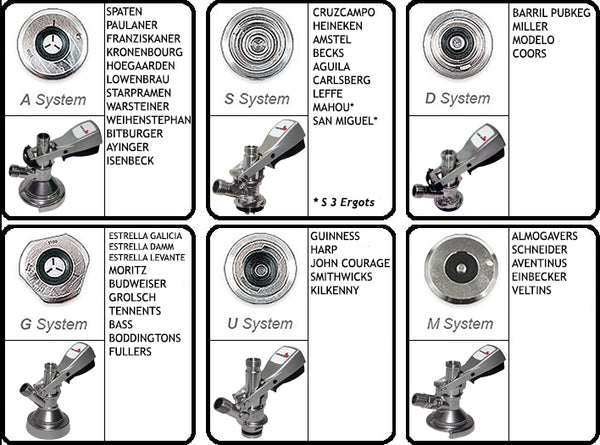
There are different models with a tinned nickel-plated brass body or stainless steel, but all models have one thing in common: every part in contact with the beer is made of stainless steel. Not all beer keg brands use the same type of valve in the keg. Each different “system” requires the coupler to match the keg valve. Micro Matic provides a table specifying each type of coupler and keg system by the best-known brands. And if you’re interested in purchasing any of them, take a look at our beer tap section.
They incorporate two anti‑return valves for optimal performance of the dispensing system:
- CO2 valve that prevents beer from flowing back through the gas line.
- Beer valve whose purpose is to prevent beer leaks when disconnecting keg couplers.
The main characteristics of these types of couplers are:
- They incorporate two check valves, one for beer and one for gas.
- Surfaces with high‑quality finishes. Very durable and easy to use.
- Careful design intended to prevent dirt build-up.
- Multiple connections for both beer and CO2. Quick-connect fittings (John Guest) or barb fittings.
- EPDM gaskets suitable for food contact.
- Easy disassembly for cleaning or maintenance.
A-type keg coupler – Flat Top German or Alumasc
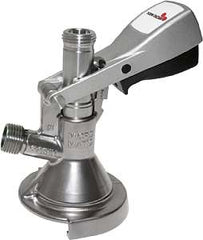

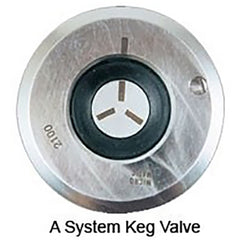
The A-type coupler has a circular flange and is very commonly used by German breweries. It is known as the German slider, since it slides over the face of the valve. It is the coupler par excellence for wheat beers, used by breweries such as Hoegaarden, Paulaner, Spaten, Warsteiner, and Weihenstephaner. It connects to the spear by a lateral/horizontal movement.
D-Type Coupler – American Sankey
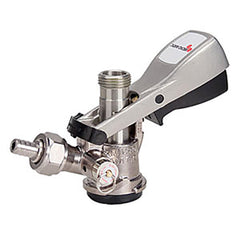

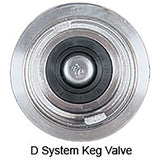
The D-type coupler is designed to work with American-style spears or “American Sankey”. It is the most common system available in the U.S. Available with 2 lugs. Used by the major American breweries: Anheuser Busch, Miller, Molson Coors and Labatt, as well as most American craft breweries. The coupler connects to the spear by turning it slightly until it stops.
G‑type Coupler – Grundy/Trilobe
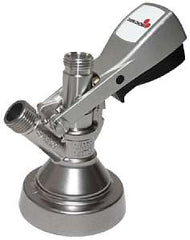

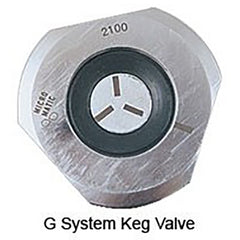
The G-type coupler has a trilobe flange and is widely used in Spain by major breweries. This system owes its name to the English promoter, Grundy. The face of the valve can be thought of as a circle with three sides cut off. It is used by breweries such as Bass, Boddingtons, Caffrey, Anchor Steam and Damm. The connection between the coupler and the spear is made by slightly turning the coupler until it stops.
L-type coupler
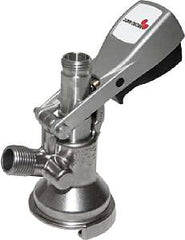
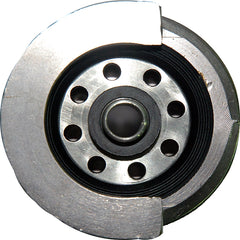

The L-type coupler has a circular flange and is used mainly for carbonated soft drink dispensers. It is the least known and least used type of coupler. It connects to the spear via a lateral/horizontal movement.
M‑type Coupler – Combi
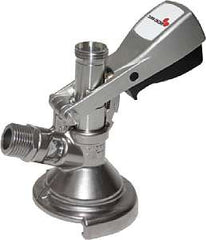
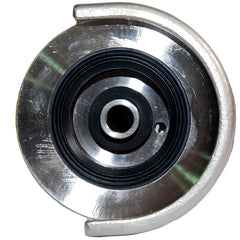
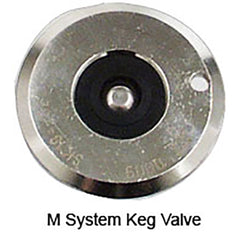
The Micro Matic M‑type coupler has a circular flange and is designed to work with M‑type spears. It was recently introduced to the U.S. market. The body is the same as the German slider, but the probe configuration is unique. Used by breweries Schneider, Aventinus and Einbecker. It connects to the spear via a lateral/horizontal slide.
S-Type Coupler – European Sankey
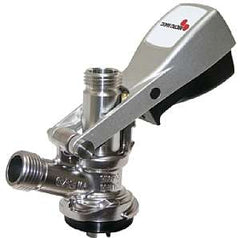
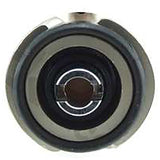
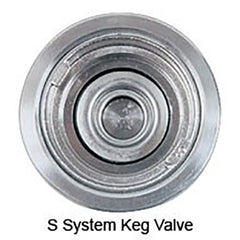
The S-type coupler is designed to work with well-type or Sankey spears, widely used in Spain by large breweries. Available with 2 or 3 lugs. Many European breweries use this system, also known as the European Sankey. It is distinguished by being longer than the D-type or American Sankey. It is used by breweries such as Heineken, Becks, Amstel, Pilsner Urquell, San Miguel, and Cruzcampo. The coupler connects to the spear by slightly turning it until it stops.
U-Type Coupler - U/E.C.
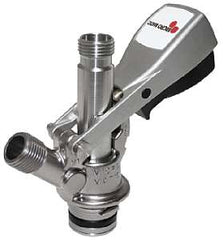
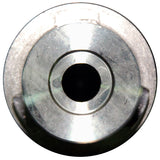
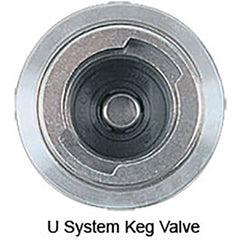
The U‑type coupler is similar to the S‑type coupler, but they are not interchangeable. This coupler is rarely used in Spain, with Guinness being practically the only brand that uses it. The system takes its name from the UEC, manufactured in England. The coupler is connected to the spear by slightly turning the coupler until it stops.
Corny Pin-Lock and Ball-Lock
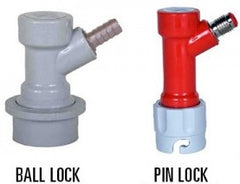
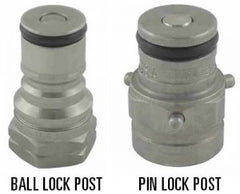
Ball-lock disconnects for Cornelius-type kegs. It consists of a disconnect for beer out (black) and a disconnect for gas into the keg (white). Both connectors have a molded barbed nozzle to fit the keg valve. There is no need for tools to connect the barbed fitting, you just push it on. This is the go-to disconnect used by homebrewers thanks to its easy cleaning and assembly. A check valve must be added to the gas disconnect, as it does not include one and beer entering the system could damage the regulator or compressor.
Cornelius keg couplers come in two varieties that have the same use and function: pin-lock and ball-lock, and they are not interchangeable. Historically, pin-lock kegs were used mainly by Coca-Cola, while ball-lock kegs were used mainly by Pepsi. On a pin-lock keg, there are metal posts (pins) that extend horizontally around the valve. When the coupler is attached, these pins are held in place. The “gas-in” valve has two pins, while the “liquid-out” has three, so it’s impossible to accidentally swap the couplers (which would result in carbon dioxide bubbling through the drink but no beverage coming out). Ball-lock kegs have ridges on the ports, which are gripped by small metal balls in the connectors.
Twin Probe (double-probe) keg spear head – Hoff-Stevens
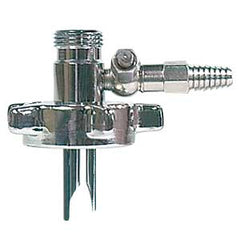
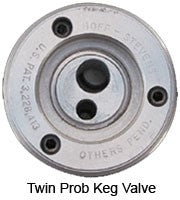
Stainless steel spear with dual-probe system that is no longer used by any major brewery. It is used to a limited extent by some American craft breweries. It has a system similar to the Cornelius Ball-Lock spear: one valve introduces the gas and the other draws out the beer.