
Beverage dispensing kegs – Systems and properties
We’re going to get a better understanding of today’s beer landscape, the types of beer kegs that exist and what the market offers us, the advantages of new recyclable plastic kegs compared to classic stainless-steel ones. We’ll look at which keg couplers are used in each keg system, compatibility with conventional filling systems, and whether the kegs are reusable or single-use (important to bear in mind for logistics and exports). A helpful overview that’s worth revisiting for all of us.
Dolium


Use of keg couplers type A, D, G and S / Reusable keg
- No deposit, cleaning, repair, waste or losses in the keg.
- Significant reduction in transport costs. Logistical efficiency (hl/m³).
- Optimized keg geometry.
- Reduced keg handling weight.
- Lower Environmental Impact (LEI).
- 100% recyclable and sustainable.
- Top quality at a competitive price.
- Integrated Pressure Relief Valve (PRV).
- Instrucciones de manipulación y seguridad. Precauciones e información de seguridad.
- Cardboard neck tag on the keg with safety instructions.
- Compatible with industrial filling lines.
- Handling weight of the 30 L keg: 1.2 kg.
- Handling (transport – stacking – rolling – dropping).
- Automatic shut-off valve that allows intermediate cleaning or disconnection.
Petainer


Use A, D and S-type couplers / One-way keg
- The Petainer family offers a significant step forward in high-volume beer sales and marketing.
- They are lightweight beverage containers made from recyclable PET (polyethylene terephthalate).
- They are available in 15, 20 and 30 liter sizes to suit a wide range of applications.
- All kegs offer economic and environmental benefits.
- The savings increase with the size of the keg. The larger the volume, the greater the savings.
- In addition to beer, Petainer is suitable for a wide range of beverages, including cider, wine, water, concentrates, and low-pressure carbonated soft drinks up to 5.5 g/l of CO2.
- The Petainer keg can be supplied in an outer cardboard box to further improve ease of handling and provide advertising for the product’s brand. They can be printed to users’ specifications to create new branding opportunities.
- Petainer offers considerable marketing and cost benefits compared to other types of kegs and also delivers real advantages for end users.
- The version adapted for conventional filling lines gives brewers the opportunity to obtain all the advantages of Petainer without having to invest in new filling systems.
- These kegs are supplied in rigid polypropylene shells that facilitate their use on steel keg filling lines.
- The housings make the kegs easy to handle during transport and for users in bars, nightclubs, and restaurants.
KeyKeg


Use of dedicated coupler KeyKeg / Single‑use keg
- The best possible quality and the longest shelf life.
- Compatible with most filling systems.
- Efficient storage and transport.
- Maximum working pressure 3.5 bar.
- No more “lost” kegs or cleaning costs.
- Fully labeled with your design/logo.
- Easy access to new markets, including exports.
- Reduced costs and higher sales.
- Recyclable and sustainable. Take care of the environment.
The innovative Bag‑in‑Ball principle provides the best possible protection for beer. This revolutionary two‑compartment system safeguards quality and extends shelf life, ensuring it is optimally protected against oxidation and never exposed to the propellant gas. Quality and safety go hand in hand with KeyKegs. The lightweight kegs meet the strictest safety requirements. Slimlines feature patented double‑wall technology that guarantees absolute safety, even if the kegs are damaged. These KeyKegs are tested to 7 bar (102 pounds per square inch) during manufacture. The KeyKeg coupler is also the only system in the world equipped with a special safety valve. Clear instructions on the packaging and in the information videos mean anyone can work with KeyKegs without any risk.
The smart design of the KeyKeg and its convenient handle make it extremely easy to handle and fill without issues. Many automatic and semi-automatic filling systems are available from KeyKeg-authorized manufacturers. Smaller breweries can also fill craft beers manually using the KeyKeg filling head. The entire exterior of a KeyKeg can be printed with your own branding. Each keg can have its own recognizable look, directly helping to increase brand recognition.
Because the kegs don’t need to be returned, KeyKeg is known as a “sell and forget” keg. The combination of using air to push, the right size, ease of use and safety now gives you access to markets that were only a dream with steel kegs. The KeyCask that was developed helps preserve the flavor of these specialty beers better than conventional cask kegs. It also significantly improves shelf life. An additional advantage is that the KeyCask can also be served with a beer pump.
PolyKeg


Use of type A, D, G, M and S couplers / One-way keg
The PolyKeg keg guarantees perfect protection for the product thanks to the special spherical shape of the top and bottom, which provides greater pressure resistance. It ensures maximum impact resistance, excellent stackability, and very good handling. It is a sustainable packaging solution that cares for the environment.
- It weighs between 0.9 kg for the lightest model and 1.8 kg for the most robust one.
- There are four types of kegs: BT, T, HS, and H models.
- High-pressure keg. Suitable for beer, wine, cider, soft drinks, etc.
- Excellent shelf life thanks to a special blend of high‑barrier polymers.
- “O2 free,” ready to be filled without sterilizing the keg beforehand.
- Pressure relief safety valve.
- Compatible with existing filling machines and current traditional GAMA distribution systems.
- Sizes: 16 L, 20 L, 24 L and 30 L.
- Colors: amber, green, silver and black.
- At the customer’s request, an inner bag can be added (making the keg reusable).
- It also opens up new business opportunities in distant markets; there is no need to invest in existing production lines, and the investment required for new production lines is lower thanks to a simplified filling line (low production costs).
- Keg management is easy and economical (no deposits, no maintenance and no waste).
- There are lower logistics costs (easy, economical palletization, no return transport and no storage).
EcoFass
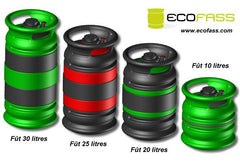

Use of type A and S couplers / Reusable keg (with disposable bags)
- This innovative product allows optimal preservation of beer, cider and wine.
- Keg sizes: 10, 20, 25, and 30 liters. With a safety valve on the keg.
- Thanks to the disposable bag, the liquid is not in direct contact with the gas, which ensures greater hygiene, the flavor of the packaged product is not altered, and its shelf life is extended.
- Using the bags also eliminates cleaning tasks, since once they are emptied they are removed and the keg is ready to be used again.
- The bag material is fully recyclable. Ecofass kegs are made from HDPE, a highly resistant plastic material.
- Lightweight design, optimizes transport by more than 20%. Easily stackable.
- No maintenance required thanks to the single‑use inner bags.
- No CO2 cylinders are needed to serve the product—just air supplied by a compressor.
EcoDraft


Use of A, D and S-type couplers / Two keg formats: single-use or reusable (with disposable bags)
- This innovative product allows optimal preservation of beer, cider and wine.
- Keg sizes: 10, 20, 25, and 30 liters. With a safety valve on the keg.
- Thanks to the disposable bag, the liquid is not in direct contact with the gas, which ensures greater hygiene, the flavor of the packaged product is not altered, and its shelf life is extended.
- Using the bags also eliminates cleaning tasks, since once they are emptied they are removed and the keg is ready to be used again.
- The bag material is fully recyclable. EcoDraft kegs are made from HDPE, a highly durable plastic material.
- Lightweight design, optimizes transport by more than 20%. Easily stackable.
- No maintenance required thanks to the single‑use inner bags.
- No CO2 cylinders are needed to serve the product—just air supplied by a compressor.
EcoKeg


Use A, D, G and S-type couplers / Reusable keg (with disposable containers)
- Fully recyclable.
- Stackable 6 high on a pallet.
- Maximum working pressure 3.5 bar.
- Commercially clean microbiological integrity, meets food-quality standards for beverages.
- 30-liter capacity.
- Maximum recommended temperature 25°C.
- Weight: 3 kg.
- Moulded using high-density polyethylene (HDPE), polypropylene (PP) and PET (polyethylene terephthalate).
- Impact resistance, semi-rigid with resistance to flexible stress cracking and good chemical resistance.
- Available in Euro and DIN keg configurations.
- Keg with 30-litre inner container.
- An FDA-approved oxygen scavenger ensures the shelf life of carbonated beverages, including beer.
- Compatible with beer filling and conventional dispensing systems.
Corny Keg

Use of exclusive couplers Pin-Lock and Ball-Lock / Reusable keg
The Cornelius keg (also known as a Corney or soda keg) is a metal container originally used by the soft drink industry. It can be used to store and dispense homemade carbonated beverages and homebrewed beer. They use their own connectors with two lines: one for CO2, which in this case is in contact with the beer, and the other for the beer to flow directly to the tap.
The keg is a stainless steel cylinder that can hold a maximum pressure of 9 bar. There are three openings in the keg: a large central hole that, by design, can only be opened when the keg is not pressurized, and two ports with valves that only open when a hose with the appropriate coupler is attached to them. The central opening is used for filling and cleaning the keg, while the two valves are used to dispense the drink. On the top there is also a pressure relief valve, usually identified by a circular ring (like a key ring).
Two metal tubes are connected to the valves inside the keg. The “gas-in” valve has a short tube that does not reach the liquid. The “out” valve has a long tube (a “dip tube”) that reaches the bottom of the keg. When pressurized gas (usually carbon dioxide and sometimes nitrogen) is introduced into the “gas-in” port, it pushes the beer from the bottom of the keg through the “liquid-out” valve to the tap. Cornelius kegs are the most commonly used by craft brewers and homebrewers as an alternative to bottling their beer, since these kegs are easier to fill, clean and maintain compared to standard industry beer kegs.
DIN Keg


Use of A, D, G, M, L, S, and U-type couplers / Reusable keg
Stainless steel kegs are, visibly, the highest quality option for beer, wine or other beverages. With custom engraving or specific labeling, stainless steel kegs can be tailored to your brand identity and your needs, with bright-polished finish as the premium option. They are easy to stack. TIG-welded at the top and bottom seams with side protection. Polished surface for easy cleaning and perfect conditioning.
DIN stainless steel beer kegs are precisely designed and finished, using AISI 304 (1.4301) stainless steel to meet the demands of industrial brewers and distributors. A full range of DIN keg sizes is manufactured to suit the market, with 20, 25, 30 and 50 liters. German-standard beer kegs (or DIN) comply with German standards DIN 6647-1 and DIN 6647-2 (for beverages in cylindrical packaging and containers). These standards have also defined keg sizes of 30 and 20 liters.
The industrial market is offered customised kegs and container solutions that use certified stainless steel to meet today’s requirements for the food and chemical industries. Beer kegs have essential components: the vessel is the result of plasma welding, without added filler material, along the circumference of two parts obtained by rolling. This makes them stronger and easier to roll. The top chime has handles to allow a secure grip for moving, and there is also a bottom chime. The top and bottom chimes are welded to the vessel by MIG welding.
Euro Keg


Use of A, D, G, M, L, S, and U-type couplers / Reusable keg
European regulations define 50, 30, 25 and 20 liters, where the shape of the keg is generally wider but shorter than the German (or DIN) keg specifications. The stainless steel Euro Keg is precisely engineered and finished, using AISI 304 (1.4301) stainless steel to meet the demands of European industrial brewers and distributors. A full range of Euro Keg sizes is manufactured to suit the market, from 16, 20, 25, and 30 up to 50 liters.
Beer kegs that comply with European regulations come in the most popular sizes of 30 and 50 liters, although the latter are prohibited in Spain. The industrial market is offered customized kegs and container solutions that use certified stainless steel to meet today’s requirements for the food and chemical industries. Beer kegs have essential components: the vessel is the result of plasma welding, without added filler material, along the circumference of two parts obtained by rolling. This makes them stronger and easier to roll. The top chime has handles to allow a secure grip for moving the keg, and there is also a bottom chime. The top and bottom chimes are welded to the vessel by MIG welding.
Variants of conventional kegs


Use of A, D, G, M, L, S, and U-type couplers
There are other types of reusable stainless steel kegs such as Optikeg, IPB Keg, IPM Keg, IPT Keg, ReadyKeg, TinKeg, or RSR Keg, which are variants and modifications of conventional DIN and Euro kegs.


