
Beverage dispensing taps – Types and features
Every home, bar, brewpub or venue has its own tastes and needs. There are many tap models with different options and features. Many variables come into play when deciding which tap best suits each need and type of drink. In addition, the installation materials and finishes will influence the look of one tap or another. We’ll provide a detailed explanation of the main features of dispensing taps.
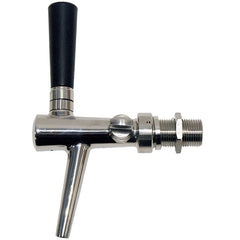
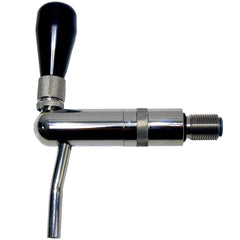
Tap style
Tap without compensator (direct flow)
These are direct‑flow taps with no internal components inside the tap body to regulate the dispensing flow; these taps allow you to pour drinks at maximum flow (and speed, depending on the pushing pressure).


These are taps with an internal mechanism that allows you to regulate the dispensing flow, preventing issues with beverage exit speed and solving foam problems when the keg is not properly counter‑pressured or is over‑carbonated, giving you more control over dispensing.


Types of taps
This is the most commonly used tap type in America. It is a short tap with a high flow capacity and no compensator, and the outlet nozzle is larger, allowing a greater volume of beverage to be poured. Although there is a version with a flow regulator, the most widely used is the direct-flow tap.

The most commonly used tap, originally from the United Kingdom, was initially designed for dispensing cask beer but is now compatible with all types of beverages. There is an option with a flow compensator regulator or direct flow. It features a quick and precise open/close dispensing mechanism. These taps allow you to add a nozzle filter that creates foam in low-carbonation beers, real ales, or beers that naturally produce little foam (for example, imperial stout).


Tap with the same features as a standard faucet but with a different opening and closing mechanism. Taps with a flow‑control compensator or direct‑flow design not only offer a different look, they also allow you to operate the tap horizontally, solving aesthetic, space, or height issues. These taps generally have a spout that pours at a right angle instead of being slanted.

The most widely used tap in the world and the benchmark in most places. This tap is the most versatile and configurable. A tap with a flow-control compensator or direct-flow option, it allows you to change the type of nozzle, the handle, and the rear tailpiece to adapt to each need and goal. It can be completely disassembled with ease and allows for quick replacement of components.

The best tap in our opinion. The tap that allows the best control over beverage dispensing. With a flow-control compensator or direct flow, it is a hybrid between the standard tap and the lever tap, since the opening and closing mechanism is vertical at a 90º angle and the tap body is an improved version of the standard tap. It is the easiest tap to keep clean thanks to its internal configuration without hidden components or recesses where beer or yeast can settle, and it also improves the dispensing flow with greater control.

This tap not only dispenses drinks but also allows you to fill PET (plastic) growlers using the same mechanism. It’s a versatile tap that works both for serving glasses to drink on-site and for filling bottles to take home. This tap gained popularity during the pandemic because it allowed customers to take drinks home with the same characteristics and quality as those served on the premises, while at the same time enabling businesses to maintain commercial activity despite restrictions and limitations. It is a more complex and sophisticated tap than other taps, as it has different mechanisms that allow both beverage dispensing, gas purging to remove air from bottles (thus preventing the drink from oxidizing), and counter-pressure filling to keep the drink’s original pressure intact until final consumption.

Tap assembly components
Construction materials
Taps can be made from different materials. The most common are metal taps made from an alloy of various metals such as brass, nickel and tin, with a stainless steel lining where the beverage flows. There are also taps whose entire body is stainless steel, undoubtedly the best and most hygienic option. Other taps are made from various plastics such as polyethylene and ABS.


Connections
The connection between the tap and the column, tower, or wall where the beverage is dispensed can be of different types. The flat connection is the one that fits into the column or tower and is designed to seal tightly without the need to thread or configure the downstream tubing, because the installation already includes it as standard. The through-flow connection allows you to screw the tap onto the tower or wall and connect the tubing with a quick-connect adapter or with metal barbs. Finally, the direct quick-connect fitting is the most convenient and simple, as it allows the tubing to be connected directly to the tap via the quick connector built into the spout. All of this depends on the installation we are dealing with and the needs that arise.


Components
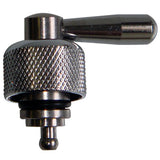
The tap is made up of multiple components that together create the dispensing system. There is the plunger of the side‑flow compensator, the plastic or metal spouts through which the drink is poured, internal springs, the internal line compensator “torpedo,” the locknuts or trim pieces, the lever that allows the handle to operate the tap, and the rear shank for installation. Depending on whether they are in contact with the beverage or not, these components may be made of alloy metal, stainless steel, or plastic.

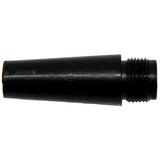


Rear tails
The shanks on the back of the taps depend on the tap model used. Normally, shanks correspond exclusively to the tap model, except for the standard tap, where you can find combinations of shanks from different models that are compatible with each other. The length and connection type also vary, as we’ve already explained. The length of the shank depends on the required application or the demands of the existing installation. For example, a long shank is needed to pass through walls or partitions where the taps are installed; otherwise, short shanks are used for installation in narrow columns that don’t allow enough room for threading the tap.


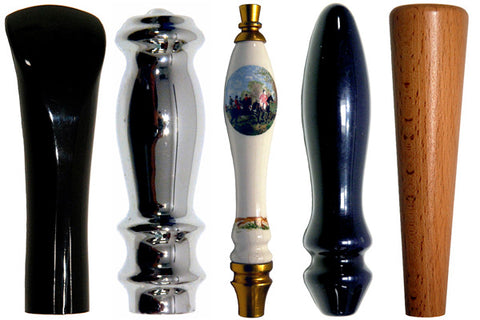
Tap handles are the most customizable and configurable element of a draft faucet. There is the composition of the handle, which can be resin, metal, plastic or wood. Handle sizes can range from small and compact to tall, ornate or screen-printed handles. Shapes also come in countless variations, always maintaining an elongated cylindrical or rectangular form but with endless designs. Colors also cover a very wide spectrum; depending on the handle’s material, there can be thousands of options.

Colors


Finishes

